


Book Review

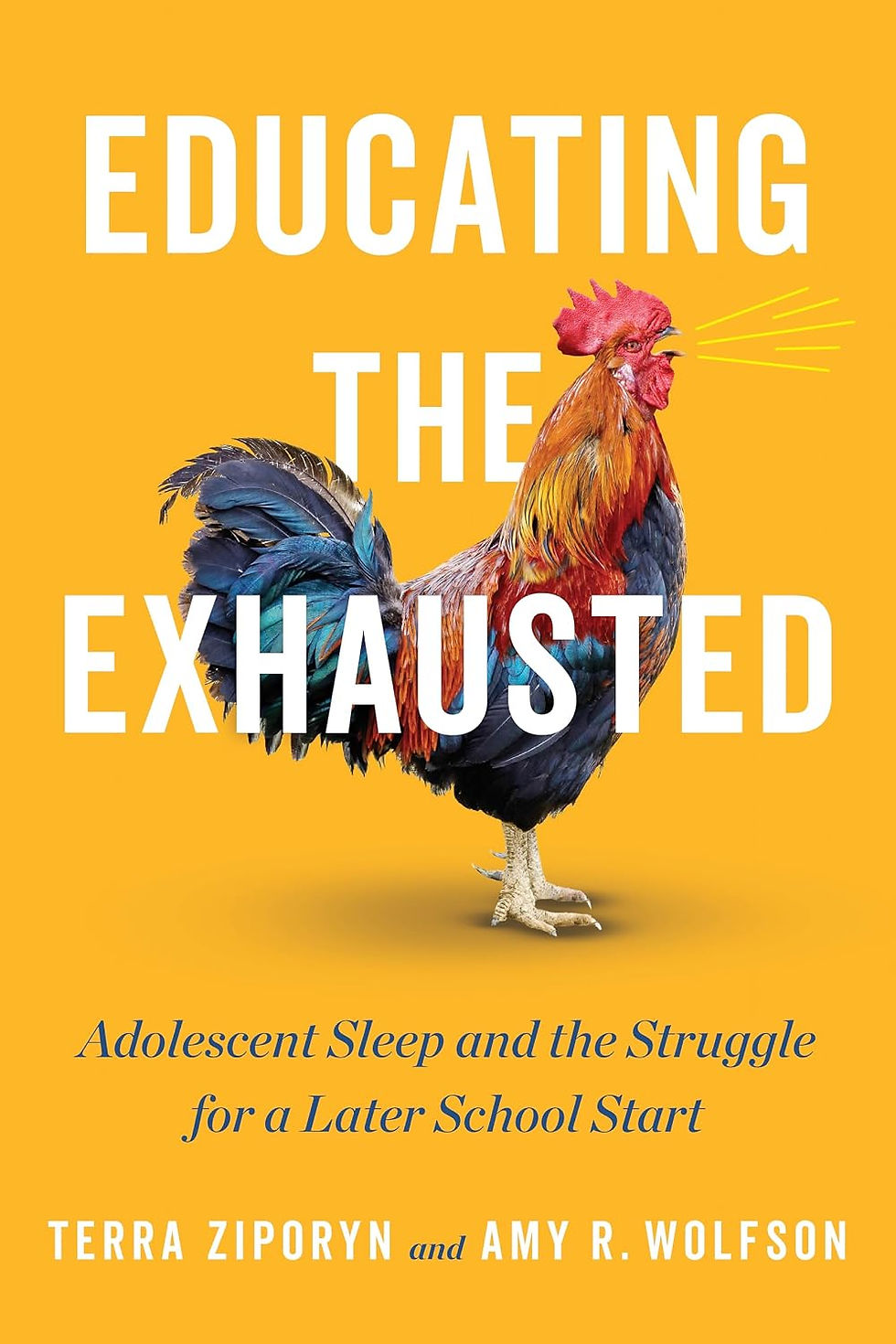
Educating the Exhausted: Adolescent Sleep and the Struggle for a Later School Start
Terra Ziporyn and Amy R. Wolfson
Johns Hopkins University Press, 2026
Reviewed by ASAP Member Prakriti Pokhrel, MD
PGY-2, Psychiatry Residency Program
Larkin Community Hospital, South Miami, Florida

In an era of mounting concern about adolescent mental health, Terra Ziporyn and Amy R.
Wolfson offer a timely reframing of an often-overlooked contributor to young people’s
well-being: the American school bell. In Educating the Exhausted: Adolescent Sleep and the
Struggle for a Later School Start, the authors examine why school schedules remain poorly
aligned with adolescent biology despite decades of sleep research and growing public-health concern. Their central argument is both simple and consequential: many American middle and high schools begin too early for adolescents to obtain the sleep their developing brains and bodies need. The book moves effectively among sleep science, public health, educational history, and advocacy, while asking a broader question about why institutions so often fail to act onwell-established scientific evidence.
This argument resonated with me in a personal way. When I first moved to the United States, I was struck by how early secondary school began. Living with my uncle’s family, I watched my teenage cousin wake at approximately 5:00 a.m. in order to arrive at school on time. Throughout the week, she appeared persistently fatigued; on weekends, she slept late into the morning, seemingly trying to recover from an accumulated sleep deficit. At the time, I assumed this reflected the ordinary rhythm of American student life. Reading Ziporyn and Wolfson’s account reframed what I had observed. Weekend recovery sleep was not simply a sign of laziness or poor self-discipline; it reflected the predictable consequences of a school schedule misaligned with adolescent circadian rhythms.
The book’s early chapters establish this biological foundation clearly. Puberty is associated with a shift toward later sleep onset and later waking, making it difficult for many adolescents to fall asleep early enough to meet the demands of an early school morning. Routine, motivation, and parental expectations may shape sleep habits, but they cannot fully eliminate the biological tendency toward delayed sleep timing during adolescence. As a result, asking teenagers to be alert, emotionally regulated, and cognitively efficient early in the morning may conflict with the developmental physiology of sleep. Ziporyn and Wolfson use the concept of a “toxic sleep environment” to describe a system in which adolescents are held individually responsible for sleep while schools and surrounding social structures make sufficient sleep difficult to achieve. Teenagers are routinely instructed to manage their time better, reduce screen use, and go to bed earlier, yet many must wake before dawn to meet school, transportation, and extracurricular demands. The related concept of social jet lag—the mismatch between biologically preferred sleep schedules and externally imposed
weekday schedules—helps explain why adolescents often sleep substantially later on weekends. This pattern is not merely a lifestyle preference; it may represent an attempt to compensate for chronic weekday sleep restriction.
For clinicians, the discussion of psychiatric and neurobehavioral consequences is among the
book’s most useful contributions. Sleep insufficiency is consistently associated with depressive and anxiety symptoms, impaired emotion regulation, daytime fatigue, and poorer overall functioning in adolescents. The authors’ attention to suicidality is particularly important. Although inadequate sleep is not a single explanation for suicidal thinking or behavior, it is a clinically relevant and potentially modifiable risk factor that deserves routine assessment in adolescent psychiatric practice.
The chapter on attention-deficit/hyperactivity disorder is equally compelling. Sleep loss can
worsen inattention, impulsivity, irritability, executive dysfunction, and school difficulties—symptoms that may overlap with ADHD or complicate its treatment. The book does not argue that ADHD is merely a consequence of inadequate sleep. Rather, it underscores the
importance of evaluating sleep duration, sleep timing, circadian delay, and daytime somnolence whenever adolescents present with attentional, behavioral, or academic concerns. For psychiatrists, pediatricians, school clinicians, and primary-care physicians, this is an important reminder that sleep assessment should be part of standard diagnostic formulation rather than an afterthought.
Where Educating the Exhausted becomes especially distinctive is in its historical and political arc. The book is not only a review of adolescent sleep science; it is also an account of the long and difficult process of translating that science into school policy. Ziporyn and Wolfson describe how sleep researchers, educators, transportation planners, athletic programs, parents, and school boards have often operated in separate professional worlds, with different priorities and definitions of feasibility. The authors show that the persistence of early start times cannot be explained by ignorance alone. Instead, it reflects institutional inertia, transportation constraints, extracurricular scheduling, parental work demands, and a cultural tendency to equate early rising with virtue.
This policy history gives the book much of its force. Ziporyn, a medical writer and co-founder of the advocacy organization Start School Later, brings an insider’s understanding of the
frustrations inherent in local school-schedule reform. Wolfson, a clinical psychologist and
adolescent sleep researcher, grounds the narrative in the developmental and clinical
consequences of sleep restriction. Together, they make clear that evidence does not automatically produce policy change. Research may establish that later school start times are likely to benefit adolescent sleep and functioning, but communities still must negotiate bus routes, athletic schedules, staffing, family routines, and political resistance before that evidence can become practice.
The authors’ treatment of the COVID-19 pandemic is also notable. Remote and hybrid learning temporarily disrupted conventional school schedules, offering an imperfect but revealing natural experiment. For some adolescents, the reduction in early-morning commuting and fixed school-start demands allowed later waking and longer sleep. The pandemic did not provide a clean model for education policy its social, emotional, academic, and economic disruptions were profound but it highlighted how strongly school timing can influence adolescent sleep opportunity. Ziporyn and Wolfson are appropriately cautious not to overstate the conclusions that can be drawn from this confounded period, yet they use it effectively to illustrate how institutional schedules shape health behavior.
The tone of the book is one of its greatest strengths. Ziporyn and Wolfson write with scientific precision while avoiding blame. They do not portray adolescents as irresponsible, parents as inattentive, or school administrators as indifferent. Instead, they locate the problem in the interaction between biology, culture, and institutional structure. Their message is ultimately compassionate: adolescent sleep deprivation should not be framed as a personal failure when the schedules imposed on young people systematically limit their opportunity to sleep.
My principal reservation is that the book occasionally moves quickly from documenting policy gains to implying broader momentum. The authors persuasively describe meaningful progress in later-start-time advocacy, including growing recognition of the issue among policymakers and school systems. Yet implementation remains uneven, and many communities continue to face practical and political barriers. A fuller exploration of the gap between legislation, recommendations, and day-to-day implementation would have strengthened the conclusion.
Readers outside the United States may also find the policy narrative heavily American, although the underlying sleep science and the broader problem of institutions resisting biologically informed scheduling are widely applicable. Ultimately, Educating the Exhausted is a book about the distance between what science knowsand what institutions do. At a time when adolescent mental health is shaped by multiple interacting pressures, Ziporyn and Wolfson make a persuasive case that chronically mistimed school schedules are a modifiable structural contributor to insufficient sleep, emotional vulnerability, and impaired daytime functioning. Their greatest achievement is not simply explaining why adolescents need more sleep, but showing why a seemingly obvious public-health intervention has been so difficult to realize.
This is an important and accessible book for psychiatrists, pediatricians, psychologists,
school-health professionals, educators, policymakers, and advocates. It belongs on the shelf of anyone working at the intersection of adolescent health, mental health, sleep medicine, and institutional reform.


Comments